Overlooking Change Orders Has a Cost
Mid-market contractors lose margin on variations nobody priced in time.
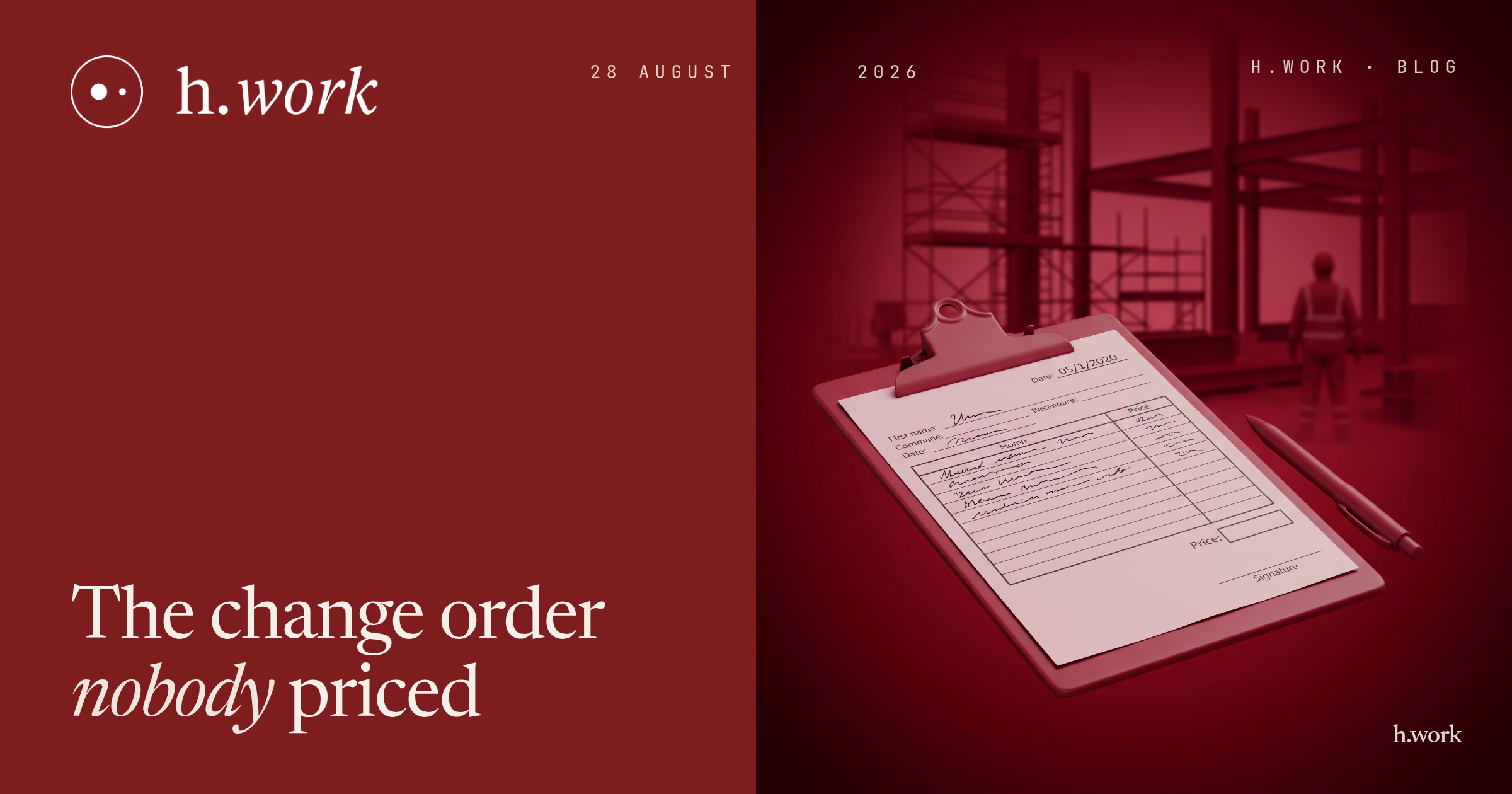
The Change Order Nobody Priced
The margin on a mid-market construction project is usually decided in the first three weeks, and almost never in the contract. It is decided in a sequence of small, undocumented moments: a foreman is asked to move a wall, agrees on the spot because the client is standing right there, and mentions it to the project manager four days later. By then the work is done, the labour is spent, and nobody has priced it.
Ask a contractor where they lose money and you will hear about materials, weather, and subcontractor scheduling. Ask them to show you the change order log and you will usually find something more revealing: entries that stop halfway through the project, several marked "verbal — to be confirmed," and a handful with a scope description but no price. Those are not clerical gaps. Each one is a conversation the company has already lost, because a change nobody priced becomes a change the client assumes was included.
Why the log always breaks in the same place
Change order management is not conceptually difficult. Someone requests a variation to scope. You price it, document it, get written approval, then execute. Every contractor knows the sequence. Most have it written into their own procedures.
It breaks because the sequence assumes a person with time, and change requests do not arrive when that person has time. They arrive mid-pour, on a Friday, from a client who has already made up their mind. The site team's incentive is to keep the job moving; the commercial team's incentive is to keep the job priced. Those pull in opposite directions and the site team is physically present, so the site team wins.
Then there is the volume problem. A single mid-sized project generates a continuous drip of small variations — a fixture substitution, an extra day of access equipment, a revised finish. None is large enough to feel urgent. Collectively they are frequently the difference between the project's forecast margin and its actual margin. The individually-trivial-collectively-decisive pattern is the exact shape of work that a busy senior person will always defer, because nothing on the list looks like the biggest problem of the day.
By the time it does look urgent, the leverage is gone. Pricing a variation before the work happens is a negotiation. Pricing it after is a request for goodwill.
What "someone should chase this" actually costs
The instinctive fix is to hire a contracts administrator or push it onto the project manager. Both routes have known failure modes.
The dedicated hire is hard to justify per project and hard to staff. A competent construction contracts administrator in a mid-market firm is a $90K–$160K fully loaded role, takes three to six months to find, and another two to four to become useful on your specific processes and your specific clients. Most firms conclude the volume doesn't warrant it and absorb the leakage instead — which is a defensible decision only if you know how large the leakage is, and almost nobody measures it.
Pushing it onto the project manager is cheaper and worse. The PM is the person whose week is already fragmented across site, client, and subcontractors. Documentation work loses to whatever is on fire. And the PM has a relationship with the client they are reluctant to spend on a $3,400 variation, which is precisely the judgement call that should not sit with the person carrying that relationship.
Splitting the chase from the call
There are two different jobs bundled inside change order management, and they need different things.
The first job is throughput and persistence: capturing every request the moment it surfaces, logging scope and source, assembling the cost build from labour, plant, and material rates, chasing the written approval, and flagging anything unpriced past a threshold. This work is structured, rule-bound, high-volume, and unrewarding. It rewards consistency and never forgetting — not seniority.
The second job is commercial judgement: whether a variation is genuinely outside contracted scope or arguably within it, whether to price at full rate or concede on a small item to protect a larger claim, when to escalate to a formal notice, how a variation interacts with programme and any delay claim. This work needs someone senior who has done it before, and it needs them at the decision point, not at month-end.
This is the split the h.work model is built around. An AI Specialist runs the first job continuously — inside the channels the site team already uses, so a foreman's WhatsApp message about moving a wall becomes a logged variation the same hour, not the same fortnight. A credentialed human expert, identity-verified through Humanity, owns the second: consequential commercial decisions route to senior review before they execute, and routine capture is monitored rather than reviewed line by line.
The economics work because oversight is shared. One consortium expert supervises Specialists across ten to thirty companies, which is what allows senior construction commercial judgement to sit over a mid-market project at 20–40% of the cost of hiring that judgement outright. Deployment runs in about 24 hours because there is no new system for the site team to adopt — the Specialist works where they already work.
What to check on your own jobs this week
Three things, and none requires a decision about vendors:
Pull the change order log for your two largest live projects. Count entries with a scope description and no price. If that number is above zero, you have an active leak, and its size is at least the sum of those entries.
Find the gap between request date and log date. If the median is more than 48 hours, you are systematically pricing variations after the work rather than before it, and you are negotiating from the weaker position every time.
Ask who decides whether a variation is in scope. If the answer is the project manager, you have put the commercial call on the person with the most relationship exposure to it. That is not a competence problem. It is a structural one, and it is fixable without moving anyone.
Change orders are the clearest case in construction operations where the money is lost quietly and the fix is unglamorous. Nobody gets promoted for a complete log. But the complete log is where the forecast margin and the actual margin stop diverging.