Nobody wrote down how this company actually works
An AI Specialist can be deployed in a day. What takes longer is context transfer.
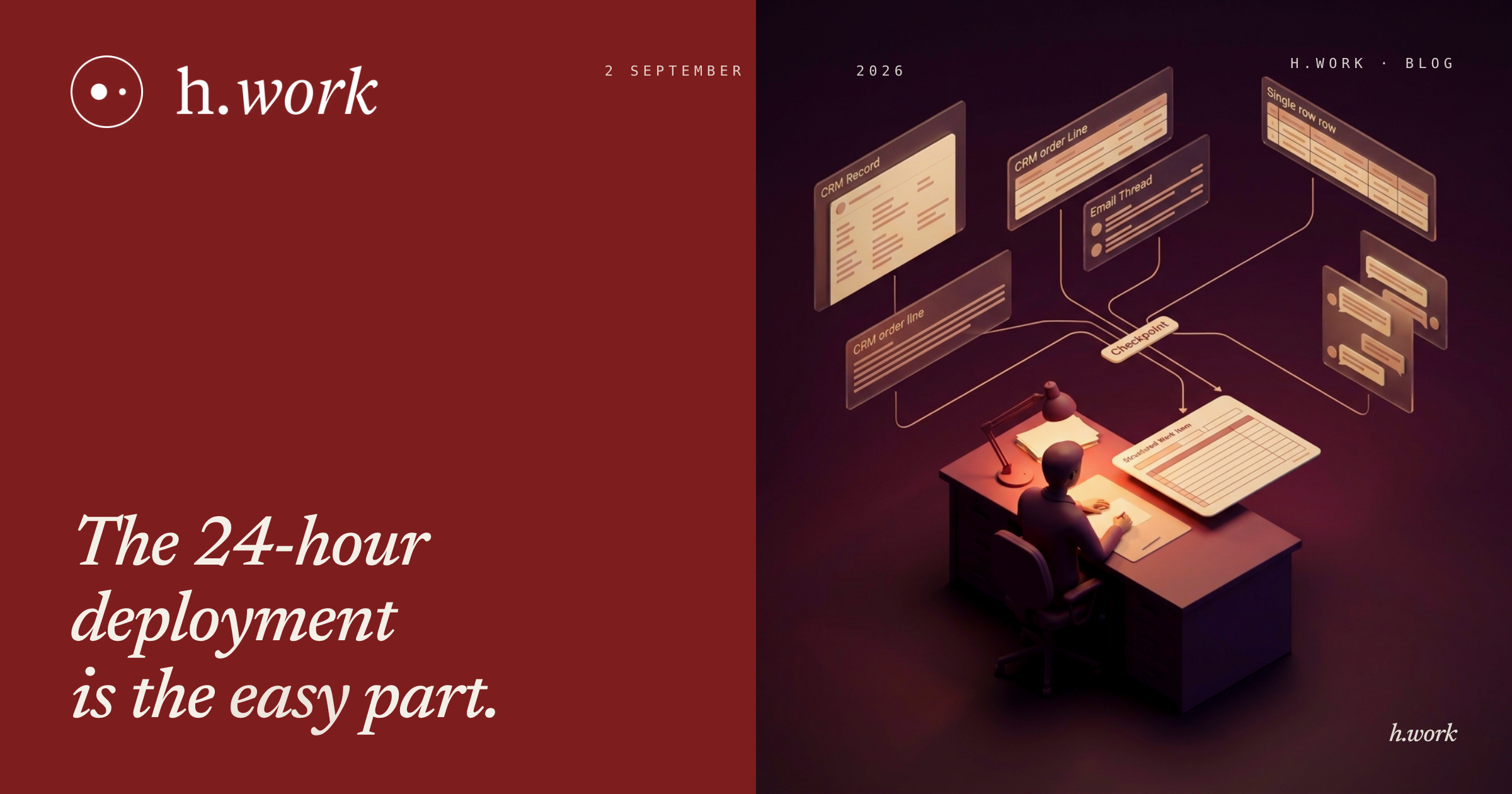
Nobody wrote down how this company actually works
An AI Specialist can be working inside a company's existing channels within a day. Slack, Teams, email, the ERP that has been running since 2014 — no procurement cycle, no platform to stand up. That part is true, and it is the least interesting thing about it.
A deployment is not an onboarding. What a company installs in a day is access. What it does not install in a day is the knowledge that makes any senior operator useful.
The part that was never documented
Consider a mid-level operations hire at a mid-market manufacturer. On paper the role is legible: vendor coordination, order exceptions, reconciliation, escalation. There is a process document, maybe an SOP folder somebody maintained until 2023.
None of that is what the hire spends eight weeks learning. They learn that one customer's purchase orders always arrive with the wrong unit of measure and get silently corrected. That one supplier's delivery dates are aspirational. That the finance lead wants exceptions over $50,000 raised before they are resolved, and a lead in another region wants the opposite.
That is tacit knowledge, and it is the substance of operational competence. The usual story about slow hiring is the three-to-six-month search. The larger, quieter delay is the two to four months after that, before the person performs at the level you hired them for. That interval is context transfer, conducted by interruption, at the expense of the people who already have the context.
Fast deployment relocates the constraint
If a Specialist is in place in a day, the bottleneck stops being availability and becomes articulation: how quickly a company can state what it already knows. More tractable than hiring — not free, and it should not be sold as free.
So the first weeks are spent doing something most companies have never done: writing down their own operating logic. Which decisions are routine, which are consequential, what the thresholds are, who owns the call when a rule does not cleanly apply.
Two things follow. The Specialist becomes competent in hours rather than months, because explicit knowledge transfers fast. And the company discovers how much of its operation was running on one person's memory — single points of failure that have been invisible only because they have never failed.
Where the ambiguity goes
Not everything can be written down in advance, and a model that demanded it would be dishonest. In the h.work model the Specialist handles structured throughput — exceptions, reconciliation, documentation, routine reporting — and consequential decisions route to a credentialed senior expert before execution, not after. Those experts are identity-verified through Humanity, which is what makes "supervised" checkable rather than reassuring.
Because ambiguity has somewhere to go, the articulation work does not have to be finished before anything can start.
Four questions, answerable in an afternoon
Which decisions here are consequential — not important, consequential. Where are the thresholds, in numbers. Who owns the call when the rule does not fit, by name. And what does one person know that nobody has written down.
Answer those and you have a productive Specialist in week one. The day-one deployment is a real advantage; it just isn't the one it looks like. What it buys is a shorter distance between spotting an operational gap and having something in place to close it — provided you know what the gap is.
Most companies do not, precisely. That is the work.
// every agent, attended.