The Empty Chair Problem in Ops Hiring
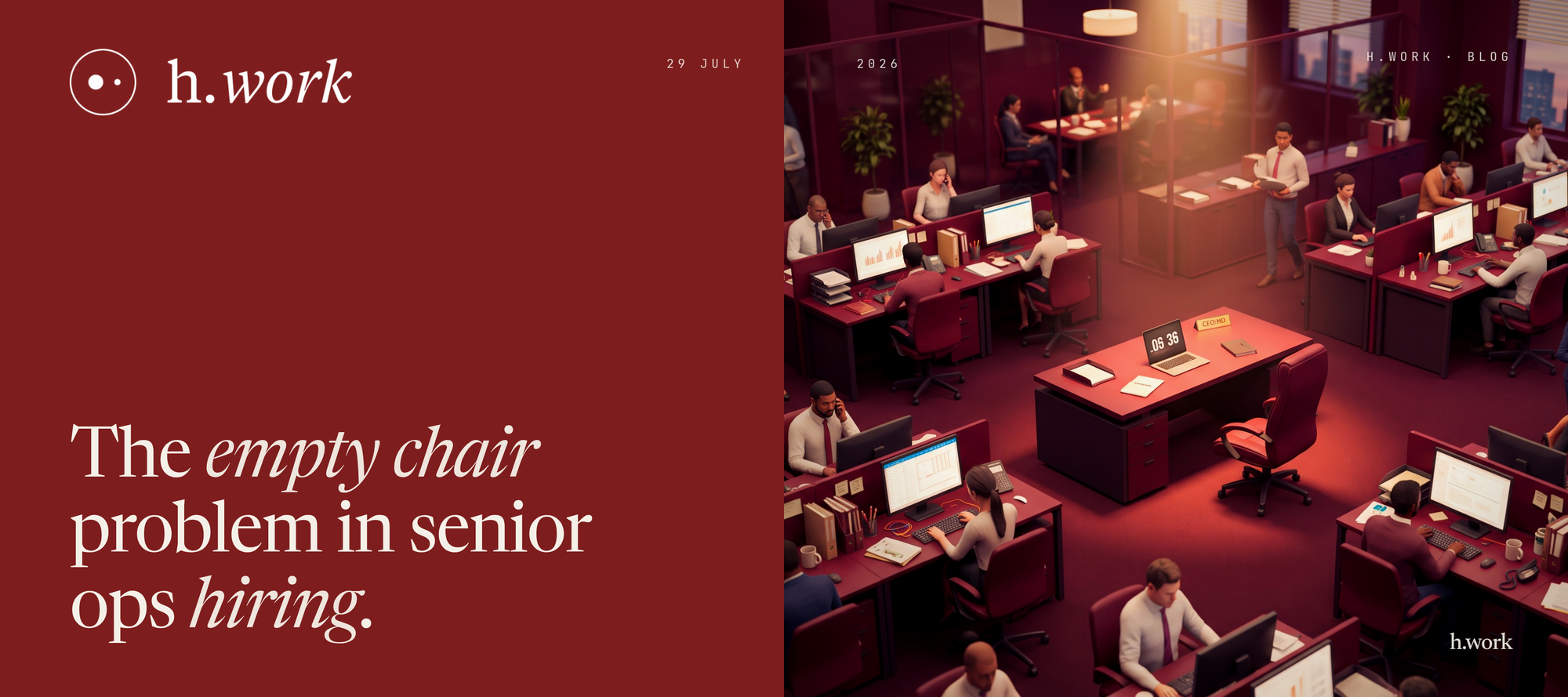
Ask a mid-market manufacturer or logistics operator what's holding back growth right now, and the answer is rarely "demand." It's the empty chair three rungs down from the top: the plant ops lead who can run OTIF and OEE numbers in their sleep, the distribution center manager who's actually implemented a WMS instead of just inheriting one, the supply chain director who can reconcile a fill-rate exception at 6am without waking anyone up.
That chair is staying empty longer, and it's costing more to fill than it used to.
The shortage isn't about applicants
Recruiters working manufacturing and logistics searches this year describe something more specific than "hard to hire": senior operations searches are taking four to six months, candidates are passive and juggling multiple offers, and the people who clear the bar are the ones who've actually led an automation or WMS/TMS/ERP implementation — not just operated inside one someone else built.
That's a skills-mismatch problem, not a headcount problem. There are plenty of people with "operations" on their resume. There are far fewer who've closed the gap between legacy processes and the AI-assisted, data-led planning tools that reshoring and expansion are now demanding. Nearly half of core operations skills are expected to shift within the next two years, and most facilities can't retrain fast enough to keep up.
Meanwhile the workforce that used to backfill these roles is aging out. Manufacturing and logistics skew older than most sectors, and the wave of retirements is landing at exactly the moment reshoring is pulling more production and distribution back onshore. Some projections put unfilled manufacturing roles in the low millions by the early 2030s if nothing changes.
The cost isn't just the salary line
Warehouse and logistics turnover runs high — often north of a third of headcount a year — and replacing a role can cost anywhere from a quarter to a full year and a half of that role's salary once you count the vacancy, the ramp time, and the mistakes a not-quite-ready hire makes along the way. Labor is 50–70% of total warehouse operating cost, so every unfilled or mis-hired seat is expensive in a way that shows up on the P&L, not just the org chart.
And the premium for the people who can actually run automated, data-driven ops is real: candidates with genuine systems and automation experience are commanding meaningfully higher pay than a straight internal promotion would cost. Mid-market companies are competing for the same small pool of automation-literate operators as the enterprises three times their size — without the enterprise comp budget or brand pull to win the bidding war.
What actually eats a senior operator's week
Talk to anyone running ops in this space and the job isn't "make judgment calls all day." It's:
- Chasing fill-rate exceptions and trade-spend discrepancies across a dozen retail accounts
- Reconciling EDI flows and PO acknowledgements that a system flagged but nobody's confirmed
- Watching cold-chain temperature data for excursions that need a call to the carrier before the load is a write-off
- Coordinating with vendors on delivery windows, documentation, and exception handling
- Producing compliance and audit paperwork that has to be right, not just done
None of that requires a $200K-loaded VP to execute. All of it requires someone with domain judgment to own — because a fill-rate exception that gets missed, or a cold-chain excursion that gets ignored, is the kind of mistake that costs a customer relationship, not just a line item.
This is the split that gets missed in most "AI will fix ops" conversations: the throughput work (monitoring, flagging, reconciling, documenting) is systematic and repeatable. The judgment work (deciding what to do about the exception, signing off on the exception report, deciding when a carrier relationship needs to change) isn't. Trying to hire one senior person to do both is why the search takes six months and the candidate you land is already fielding two other offers.
Splitting the job instead of hiring around it
The alternative isn't "replace the ops hire with AI" — fully autonomous decision-making on fill-rate exceptions or cold-chain excursions is not something any serious operator should want, and it's not what the tooling is actually good at yet. The alternative is splitting the role the way the work already splits.
AI Specialists can run the throughput layer continuously: monitoring shipment temperatures around the clock, flagging PO mismatches the moment they appear, tracking fill-rate exceptions across every account instead of the three someone remembered to check this week, and keeping the documentation trail current without anyone doing it as a Friday-afternoon catch-up task.
The judgment layer doesn't disappear — it gets routed to a credentialed expert instead of absorbed into a single overloaded hire. A senior domain specialist reviews the exceptions that actually need a human call, signs off before anything consequential ships, and corrects the pattern so the next similar case gets caught earlier. One expert, working this way, can reasonably oversee AI Specialists supporting ten to thirty companies' worth of this work — not because the judgment is automated, but because the volume of routine work that used to consume their day is no longer theirs to do manually.
For a mid-market manufacturer or 3PL, that means the senior hire you've been searching for since spring doesn't have to be one person doing everything from EDI reconciliation to strategic vendor negotiation. It can be a properly staffed operation: AI Specialists running the structured throughput, a verified expert holding the judgment calls, deployed into the Slack, email, or ERP you already use — without a six-month search and without betting the department on a candidate who's still deciding between your offer and someone else's.
The actual trade-off
This isn't a pitch that automation is free or that judgment can be skipped. It's the opposite: the reason expert oversight matters here is because fill-rate exceptions, cold-chain calls, and vendor disputes have real consequences. The trade-off worth making in 2026 isn't "AI versus expert" — it's whether the scarce, expensive, hard-to-find expert judgment in your operation is spent on reconciling PO flags by hand, or on the calls only they can make.