Temperature Excursions That Slip Through the Cracks
Cold chain alerts are cheap. The disposition decision and the paperwork behind each one are not — and that is the work most shippers quietly skip.
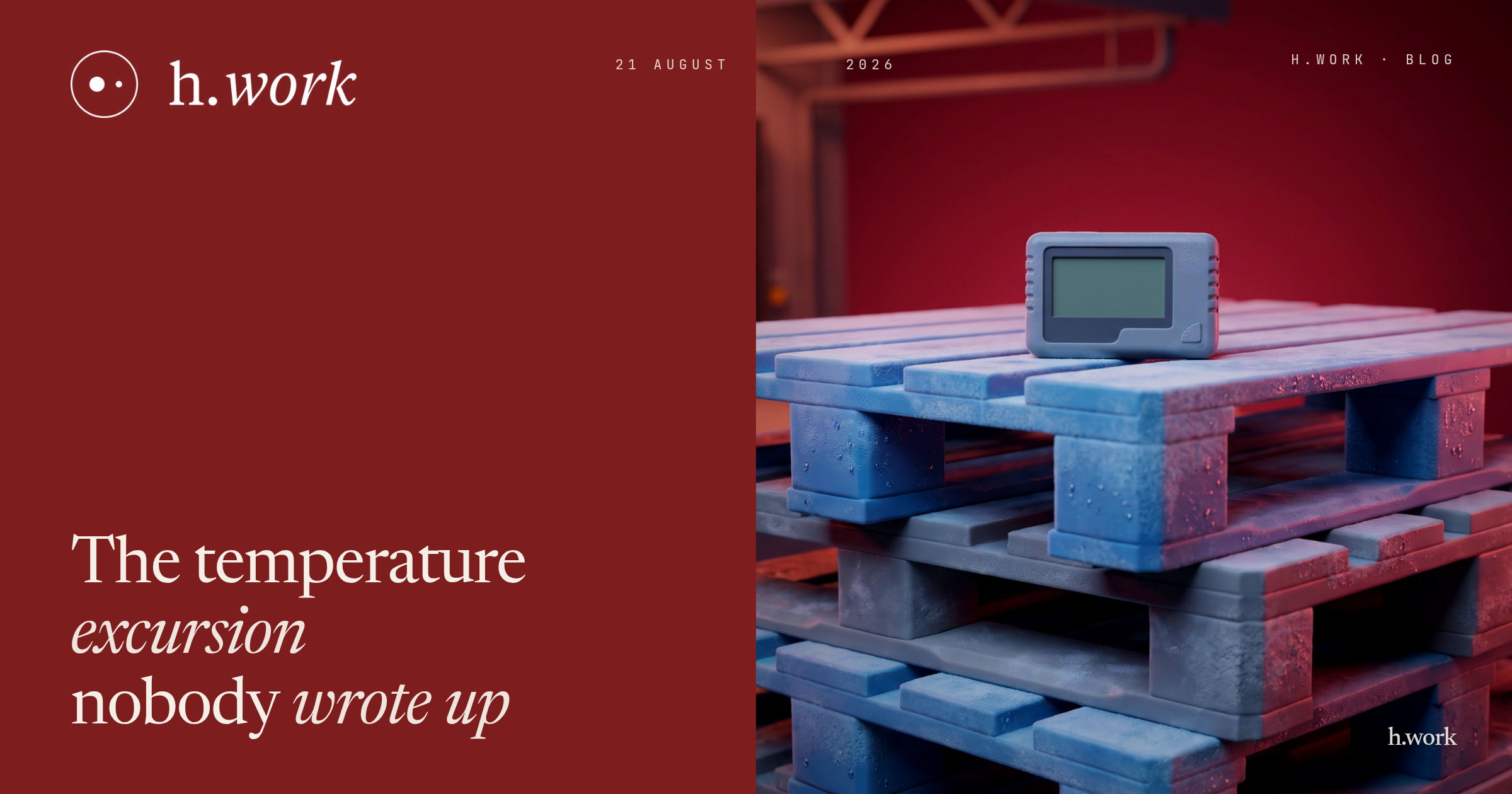
The Temperature Excursion Nobody Wrote Up
Every refrigerated load is instrumented now. Data loggers in the trailer, probes in the pallet, telematics on the reefer unit, a portal that emails you when the setpoint drifts. Ask a cold chain manager how many excursion alerts they got last month and they can tell you within ten. The monitoring problem is solved.
Ask them how many of those alerts have a written disposition on file — accept, hold, reject, with the reasoning and the sign-off attached — and the number changes shape. It becomes an estimate. Then it becomes a sentence about how busy Q3 was.
That gap is the actual cold chain risk, and it has nothing to do with sensors.
The alert is not the work
An excursion alert says a temperature went out of range. It does not say whether the product is still good.
Answering that requires someone to pull the full logger trace rather than the alarm summary, check how long the load sat above threshold and at what magnitude, compare that against the product's stability data or the customer's specification, look at whether the deviation happened in transit or on a dock during a two-hour detention, decide accept / hold / reject, and write the whole chain of reasoning into the quality record with a name against it.
Twenty minutes when it is clean. Two hours when the logger disagrees with the telematics, or the receiver has already put the pallets away, or the spec sheet is ambiguous about cumulative versus single-event exposure.
Now multiply. A mid-market food distributor running 600 reefer loads a month with a 6% alert rate has around 36 of these a month. A pharma 3PL with tighter limits will trip more. Nobody staffs 36 investigations a month as a job. It lands on a quality coordinator who also owns supplier audits, or on a logistics manager who also owns carrier rates, and it gets triaged the honest way: the loads where a customer complained get documented properly, and the rest get a glance and a mental pass.
Why the undocumented ones are the expensive ones
The load you rejected is not your problem. You made a decision, you ate the cost, it is visible.
The problem is the load you accepted without writing down why. Nothing happens for months. Then one of four things does.
A customer's QA team asks for excursion records on a lot they are investigating, and you have alerts without dispositions — which reads, to an auditor, as no quality system at all rather than as a busy quarter.
An audit — customer, regulatory, or certification — samples the deviation log and finds alerts that terminate in silence. The finding is not "you shipped bad product." The finding is that your process is undocumented, which is worse, because it applies to everything you shipped.
A claim goes to the carrier and you cannot substantiate where in the chain the temperature broke, so you absorb a loss that was somebody else's.
Or a genuine excursion gets waved through by pattern-matching against the last thirty that were fine, and product reaches a patient or a shelf that should not have.
Three of those four are paperwork failures, not judgement failures. Somebody made a defensible call and never wrote it down. That distinction matters, because it tells you what to fix.
Splitting the work correctly
The evidence assembly is mechanical and it is the majority of the clock. Pulling the logger file, aligning it to the telematics and dock timestamps, calculating time-above-threshold and mean kinetic temperature, matching the load to the product spec and the customer agreement, drafting the deviation record, chasing the carrier for the detention detail, filing everything against the lot and the shipment, and flagging the loads that fall outside routine tolerance.
The disposition is judgement. Whether this product, with this history, for this customer, in this regulatory context, is fit for release. Whether a pattern of small excursions on one lane is a carrier problem worth escalating. Whether an ambiguous spec should be read conservatively. That decision needs a name on it, and the name needs credentials — a quality professional who can defend the call in front of an auditor and who is accountable for it.
This is the split h.work builds around: AI Specialists handle throughput, credentialed human experts hold judgement. A logistics or quality-operations Specialist works inside the systems already in place — the TMS, the monitoring portal, the quality management system, email, Slack — and turns every alert into a complete, structured case file within hours. Routine, in-tolerance dispositions clear under continuous oversight. Anything consequential routes to a senior expert before it is executed, and that expert's correction feeds back into how the Specialist handles the next one.
The economics are the point. Consortium experts are identity-verified and credentialed through Humanity, and one expert can supervise Specialists across ten to thirty companies — which is why credentialed oversight stops being a full-time headcount problem. A Manager-tier Specialist runs $3K–$6K a month against a mid-level quality or logistics hire at $90K–$160K fully loaded. The comparison is not "software versus person." It is thirty-six investigations a month getting documented, versus six of them getting documented and the other thirty living in an inbox.
Monthly terms, deployed into your existing stack, no annual lock-in. If the excursion volume drops because a carrier problem finally became visible, you scale it down.
The test
Pull last month's excursion alerts. Count them. Then count how many have a written disposition with a name attached.
If those two numbers are close, your monitoring investment is doing what you bought it for. If the second is a fraction of the first, you do not have a cold chain visibility problem. You have thirty undocumented decisions a month, and every one of them is a promise that somebody, at some point, will ask you to keep.
Slug: temperature-excursion-nobody-wrote-up
Meta description: Cold chain alerts are cheap. The disposition decision and the paperwork behind each one are not — and that is the work most shippers quietly skip.