The AI Specialist Should Not Be Another SaaS Bill
The real cost question is not whether AI is cheaper than a hire. It is whether the work is owned, supervised, integrated, and accountable.
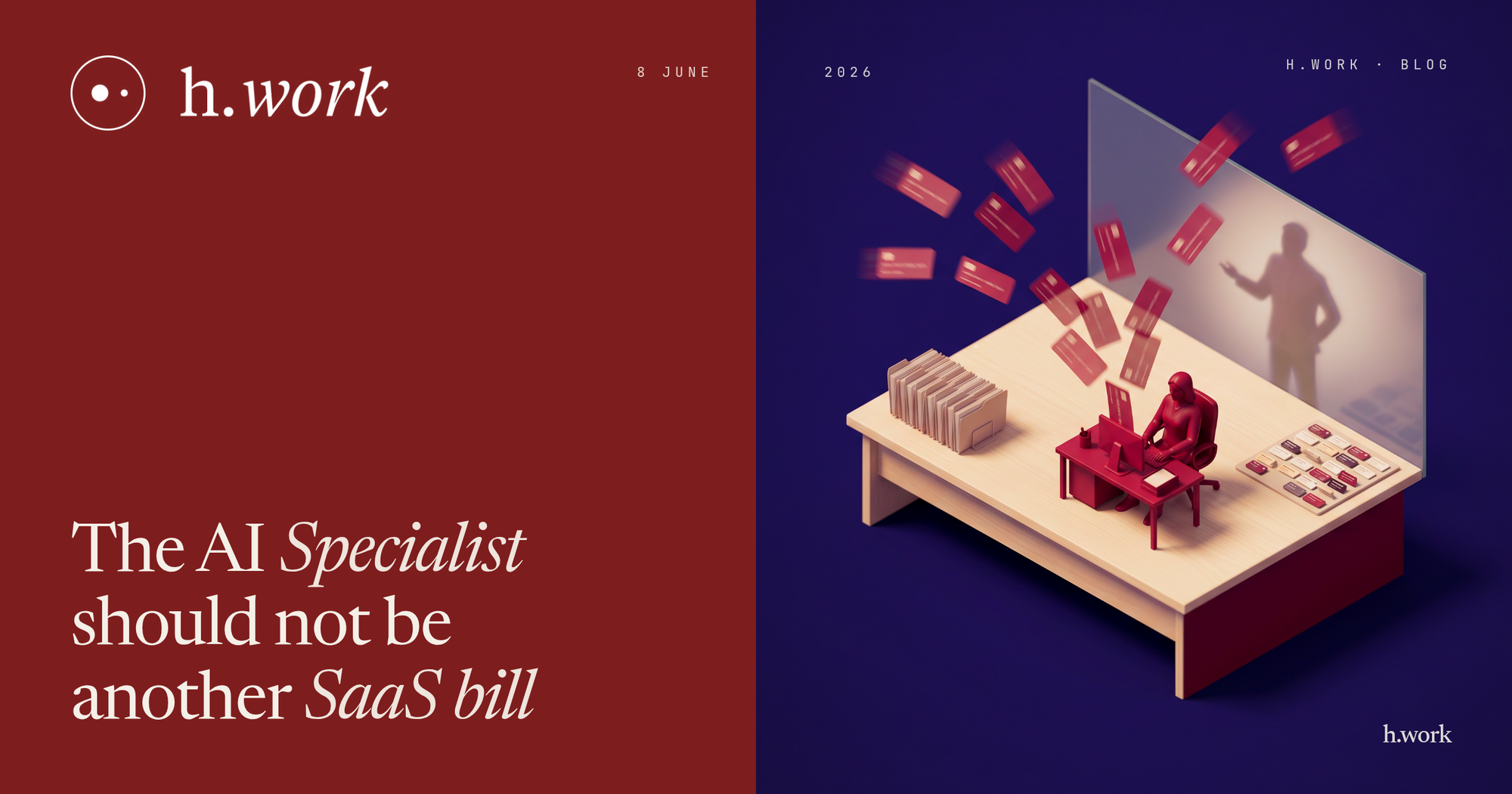
The AI Specialist Should Not Be Another SaaS Bill
Every operations leader has seen this movie.
A team hits capacity. The obvious answer is a new hire, but the requisition takes weeks to approve, months to fill, and another quarter before the person knows the business well enough to be useful without constant supervision. While the role sits open, the work does not wait. Customers still email. Invoices still need reconciliation. Exceptions still pile up in the ERP. Managers still spend evenings moving information between systems because the process depends on them being the glue.
Then the AI conversation starts.
Someone proposes a tool. Then another. Then a workflow builder. Then a specialised agent for one department, a chatbot for another, and an analytics layer to make sense of what the first four systems did. Each line item looks small compared with a salary. The combined cost is harder to see.
That is the wrong way to buy an AI workforce.
The question is not whether an AI subscription is cheaper than an employee. Most are. The better question is whether the work now has an owner.
The Real Comparison Is Fully Loaded Work
Hiring costs are rarely limited to salary. A company pays recruiting costs, management time, onboarding, benefits, software seats, equipment, training, turnover risk, and the productivity gap while the person ramps. For mid-market operators, the delay is often as painful as the cost. A finance role that takes four months to fill still leaves four months of reconciliations, reporting, vendor follow-up, and month-end pressure behind.
This is why simple "AI versus employee" comparisons are usually too shallow.
A low-cost AI tool may look efficient on a procurement sheet, but it still needs someone to configure it, connect it to workflows, monitor its output, correct mistakes, and decide when a task should be escalated. If that work falls back onto the same manager who was already overloaded, the company has not reduced operational pressure. It has moved it.
The result is familiar: more software, more notifications, more partial automation, and no clear accountability for the outcome.
An AI Specialist should be measured differently. The unit of value is not the seat. It is the role.
Tool Sprawl Is Not a Workforce Model
AI adoption has created a new version of an old problem: SaaS sprawl. Departments add tools quickly because the individual purchase feels harmless. Over time, the company inherits duplicate systems, unclear ownership, uneven security practices, and workflows that only one person understands.
Agentic AI can make that worse if every team builds its own small agent without a common operating model. The business may automate fragments of work, but the operating burden stays human. Someone still has to know which agent touches which customer record, which system is the source of truth, which outputs can be trusted, and which decisions require review.
For a mid-market company, that matters. These teams do not have unlimited IT capacity, transformation offices, or spare process architects. They need operational relief, not another layer of coordination.
This is where the workforce model is different from the tool model.
A tool waits for the company to decide what to do with it. A Specialist is hired against a role. It has defined responsibilities, defined channels, defined escalation paths, and defined oversight. The company is not buying access to a capability. It is assigning work to a named operator.
That distinction sounds simple, but it changes the total cost of ownership.
The Hidden Cost Is Supervision
Every serious AI workflow needs supervision. The only question is whether supervision is designed into the model or quietly dumped onto the customer.
Routine work can be automated when the inputs, rules, and desired outputs are clear. Purchase order follow-up, invoice matching, support triage, shipment monitoring, listing updates, data cleanup, and standard reporting all contain large amounts of repeatable work. AI is well suited to that throughput layer.
Judgement is different.
A customer escalation may look routine until the account history says otherwise. A compliance item may appear complete until a regulatory nuance changes the risk. A finance exception may be technically reconcilable but commercially wrong. These are not always "AI failure" cases. They are judgement cases.
h.work is built around that split. AI Specialists handle the volume. Human experts handle the judgement layer. Consequential decisions are routed to credentialed practitioners before execution. Expert corrections become quality control for the client and training signal for the Specialist.
That is not a cosmetic add-on. It is the part of the operating model that prevents AI from becoming another unmanaged system.
Pricing Should Be Anchored to the Hire You Avoid
The cleanest way to price an AI Specialist is to anchor it to the internal hire the company would otherwise make.
If the work is front-line operations, the comparison is an entry-level hire plus management overhead. If the work requires domain judgement, the comparison is a mid-level operator or manager. If the work touches reporting, compliance, investor communications, or regulated processes, the comparison is a senior specialist or expert.
h.work prices AI Specialists at 20 to 40 percent of the fully loaded cost of the hire they replace or augment. That matters because it forces the buying decision back to operational economics.
The company is not asking, "Is this cheaper than a software subscription?"
It is asking:
- Which role would we hire if money and time were not constraints?
- What work actually needs senior judgement?
- Which tasks are repeatable enough for AI throughput?
- Who supervises the edge cases?
- How quickly can this capacity be live inside the channels we already use?
Those are better questions. They produce a cleaner answer.
The Best AI Workforce Disappears Into the Work
Mid-market companies rarely need a dramatic AI transformation programme. They need the order queue cleared, the month-end pack prepared, the customer exceptions handled, the vendor follow-ups sent, the listings corrected, the claims documented, the shift reports structured, and the compliance trail maintained.
They need work to move.
That is why deployment matters as much as capability. An AI Specialist that requires a new platform, new rituals, and a long implementation project may be impressive in a demo and expensive in practice. The useful version works where the business already works: Slack, Microsoft Teams, email, WhatsApp, WeChat, LINE, ERP, CRM, accounting systems, e-commerce platforms, and the ordinary channels where operations actually happen.
The less the company has to reorganise around the AI, the faster the value shows up.
This does not mean zero configuration. Every useful Specialist needs context: business rules, approval thresholds, system access, reporting formats, escalation paths, customer-specific preferences, and the line between routine execution and expert review. But that configuration should support the role, not become the role.
The Outcome Is Capacity With Accountability
The promise of an AI workforce is not that humans disappear from operations. It is that human judgement stops being wasted on repeatable throughput.
A finance manager should not spend half the week chasing invoice details across email threads. A logistics lead should not manually refresh carrier updates at midnight. A customer service manager should not personally triage every common inquiry because the queue has outgrown the team. A property operations lead should not be the only person who can turn maintenance notes into structured follow-up.
Those are capacity problems. Hiring can solve them, but slowly and expensively. Software can help, but only if the company has the time and expertise to turn software into owned work.
An AI Specialist sits between those options. It gives the company role-based capacity without pretending that judgement can be automated away. The work gets a named owner. The edge cases get expert oversight. The cost is tied to the hire the company would otherwise make, not to a growing stack of disconnected tools.
That is the standard operators should use.
If an AI solution is just another SaaS bill, it will eventually be judged like one: usage, renewal, consolidation, cancellation.
If it performs like a member of the workforce, it should be judged by a harder and more useful measure: the work that no longer waits.