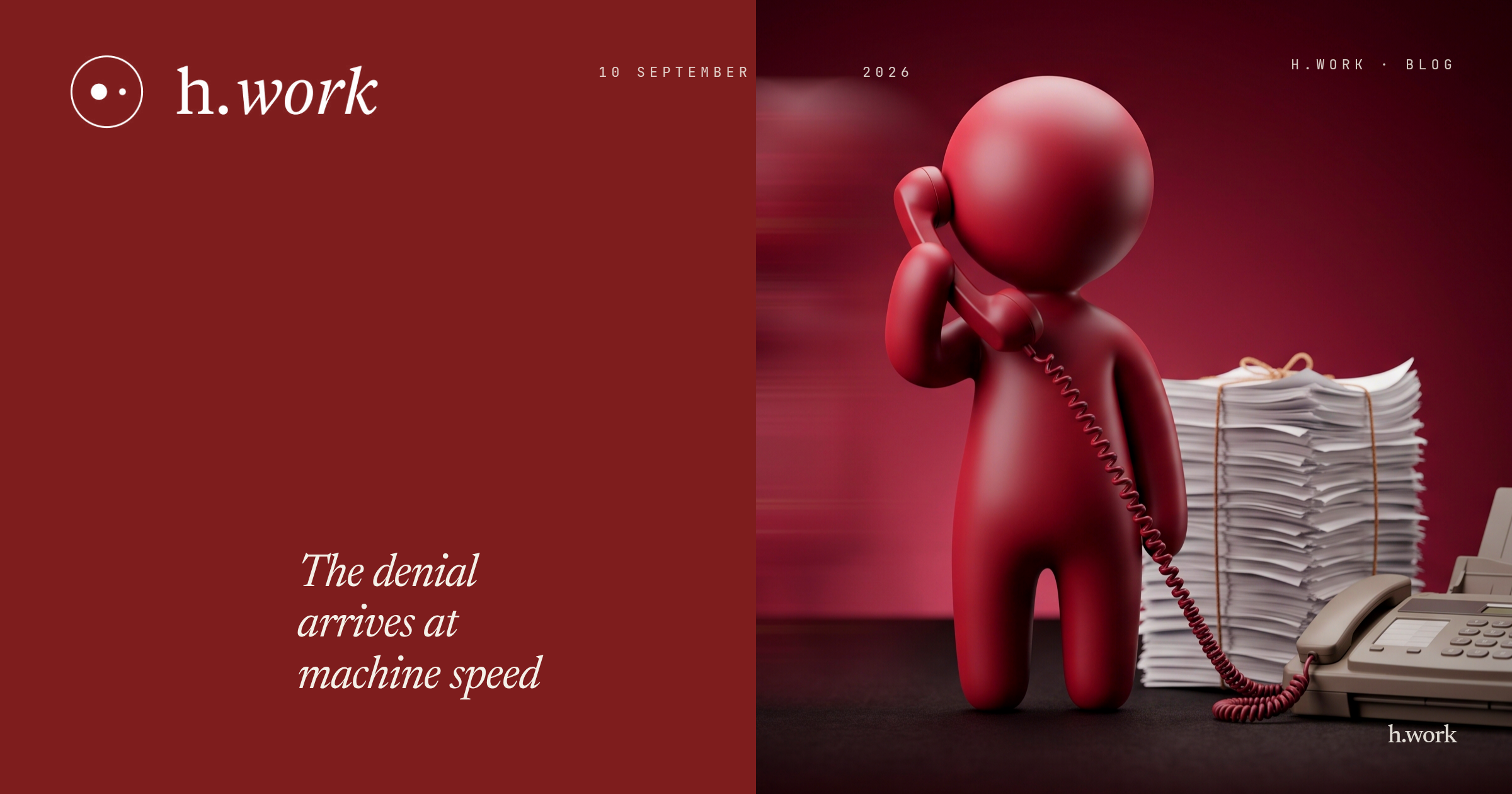
The denial arrives at machine speed
Payers now decide prior authorisations with AI in seconds. Providers still answer with fax machines and phone queues. The asymmetry is the story — and the staffing question it creates.
A physician orders an MRI. The request leaves the practice management system and crosses to the payer, where a model reviews it against the plan's medical policy, the patient's history, and the payer's own utilisation thresholds. The answer comes back before the referral coordinator has finished documenting the call: denied, insufficient conservative therapy.
The decision took seconds. The response will take days.
This is the new shape of prior authorisation in 2026. The payer side has industrialised. Industry surveys now describe the large majority of insurers using AI somewhere in utilisation management, and entire vendor categories exist to sell "auto-adjudication" to health plans. The provider side has not. At most practices, the appeal still moves at the speed of a human with a fax line, a phone queue, and forty other requests waiting in the same stack.
The American Medical Association's survey numbers have barely moved in a decade: roughly forty prior authorisation requests per physician per week, thirteen to fourteen staff hours a week consumed by the process, and over nine in ten physicians reporting that the process delays care. What has changed is the tempo on the other side of the counter. Requests used to disappear into a human queue and return at human pace. They now return at machine pace — often as denials — and the machine does not get tired.
An asymmetric negotiation
Each side of this transaction now runs on a different clock.
The payer's model can evaluate every request, every time, against every clause, without fatigue and without mercy for context it was not given. It does not know that this patient already failed two rounds of physical therapy, because that detail lives in a scanned PDF attached to a different claim. It knows what was submitted, in the fields it reads.
The provider's answer is a coordinator — or a nurse, or the physician at 7pm — assembling an appeal by hand: pulling the chart, drafting the letter of medical necessity, attaching the imaging reports, getting it signed, sending it, and then checking a portal every day for a status change. A single contested authorisation can consume hours across several people. Multiplied by forty requests a week, it is not a workflow. It is a parallel job.
Practices have responded the way mid-market companies always respond to a volume problem: they hire for it. The prior-auth coordinator is now a standard role, and a hard one to keep filled, because the work is repetitive, adversarial, and unrewarding. Turnover is high. The knowledge of which payer wants which phrasing leaves with each departure.
What the denial actually contains
Strip the framing away and a machine-generated denial is a structured document with a small number of moving parts: the policy clause cited, the criterion judged unmet, the patient data the model could see. Contesting it is also structured work — retrieve the missing context, map it to the cited criterion, present it in the format this payer's review process accepts.
This is throughput work. It is high-volume, rule-bound, and auditable. It does not require a physician's judgement to assemble. It requires knowing where the context lives, which criterion is in play, and what a complete, well-formed response looks like for that payer.
What does require judgement is the layer above: whether the appeal is clinically warranted, whether the case should escalate to a peer-to-peer review, whether a pattern of denials against a particular policy merits a formal complaint or a contract conversation. Those calls belong with humans — with the physician, the practice manager, the senior revenue-cycle lead who has read this payer's behaviour for years.
The current arrangement gets the split backwards. The model generates volume; senior humans drown in it, doing assembly work that is beneath their licence, while the genuinely consequential judgement calls queue behind the paperwork.
Attending the other side of the machine
An attended AI workforce model approaches the asymmetry from the provider side. An AI Specialist trained for the revenue cycle does the structured half: monitors the authorisation queue, reads each denial against the cited criterion, pulls the relevant chart context, assembles the appeal in the payer's accepted format, tracks status, and escalates on schedule. It works inside the practice's existing systems, around the clock, at the same tempo the payer's models work.
Every action is logged. Every document it sends is reconstructable: what was submitted, to whom, when, under which case reference. The audit trail that a manual process scatters across inboxes and sticky notes becomes the by-product of the work itself.
The judgement half stays with credentialed humans. A clinical appeal gets clinician sign-off before it leaves. A pattern of denials goes to the senior expert supervising the deployment — someone who has run revenue cycle operations, who can read a remittance the way a physician reads a chart, and whose corrections feed back into the Specialist's future work. One experienced supervisor can hold that layer across a caseload no in-house coordinator could touch, because their hours go to decisions rather than assembly.
The result is not a practice that argues with machines more aggressively. It is a practice that answers at the same speed it is answered at, with senior human judgement reserved for the cases that genuinely need it.
What this is not
This is not a claim that payer AI is illegitimate, or that denials are always wrong. Many prior authorisation decisions are correct, and the utilisation question behind them is real. Nor is it a claim that a provider-side agent should auto-appeal everything. That would simply add machine noise to a system already drowning in it.
The argument is narrower. When one side of a high-stakes administrative process operates at machine speed, the other side cannot remain staffed for human speed and expect a fair outcome. Either the volume goes unanswered — which is what denial rates quietly count on — or the answering gets attended automation of its own: AI doing the assembly, humans holding the judgement.
It is also not a claim that the underlying policy fight disappears. The thirteen staff hours a week are a symptom of a structurally adversarial system, and no deployment changes that system. What changes is who absorbs the friction. At the moment, it is absorbed by clinicians in the hours after the last patient leaves.
The question worth asking
Every prior authorisation workflow now contains a silent question: when the denial arrives at machine speed, who answers at machine speed — and who checks their work.
The practices that answer honestly tend to find that the bottleneck was never clinical judgement. It was the assembly line standing between the judgement and the payer's clock.