The Judgement Gap: AI Is Making Your Team More Capable — and That's Exactly Why You Need Better Oversight
Microsoft's 2026 Work Trend Index found 58% of AI users can now produce work they couldn't a year ago. The same data reveals quality control has become the workplace's most-wanted skill. Here's what that means for how teams work.
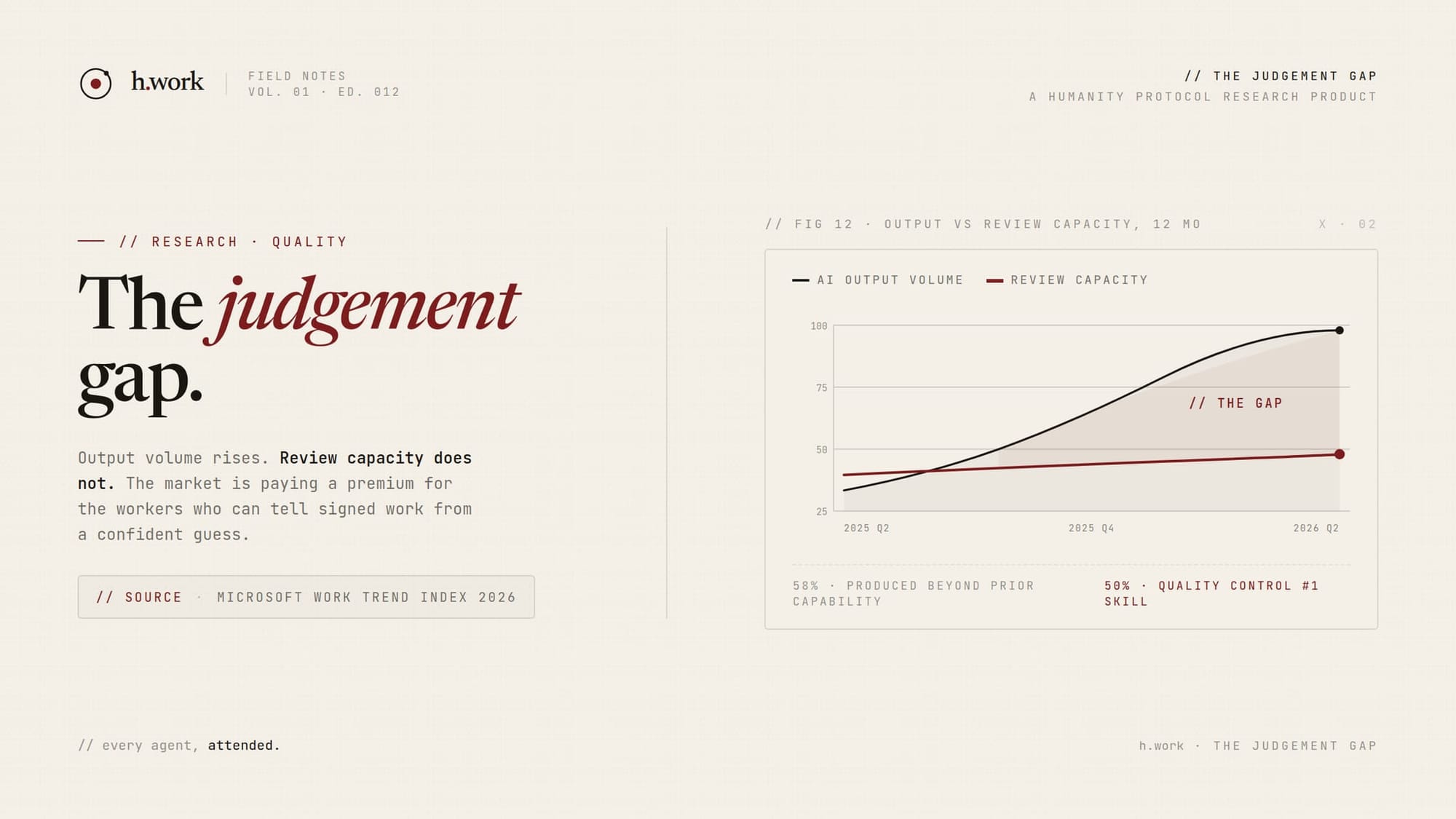
There's a number from Microsoft's 2026 Work Trend Index that made the rounds in May. You've probably seen it: 58% of AI users say they're now producing work they couldn't have produced a year ago.
It landed well. It's a good number — optimistic, concrete, big enough to matter. Tech press ran with it. LinkedIn was full of it. And it's true.
Here's the number that didn't make the rounds.
The headline number everyone shared — and the one nobody mentioned
In the same survey — 20,000 workers across 10 countries — Microsoft asked a different question: as AI takes on more work, which human skills become more important?
The top answer, cited by 50% of respondents: quality control of AI output.
Second: critical thinking — analysing information objectively and making a reasoned judgement. 46%.
Not prompt engineering. Not speed. Not volume. The skill workers most want to sharpen, as AI expands what they can produce, is the ability to evaluate whether what came out the other end is actually right.
Two numbers from the same dataset, three weeks apart in terms of media attention. The gap between them is the gap this post is about.
Why more capability creates more exposure, not less
The instinct, when AI raises the ceiling on what your team can produce, is to move faster. More drafts, more analyses, more reports, more pitches — because the cost of generating them has dropped.
That instinct isn't wrong. But it has a tail risk that doesn't show up in your productivity metrics.
When a team's output volume doubles but its review capacity stays flat, the exposure doesn't stay flat — it compounds. More AI-generated content in circulation means more surface area for errors, hallucinations, and confident-sounding claims that haven't been verified. The bottleneck shifts from production to judgement. And if you haven't invested in judgement, you've built a faster machine with a weaker brake.
This is not an argument against AI. It's an argument for being deliberate about what human effort is now for.
The 86% signal: workers already know this
The WTI data contains a quiet confirmation of the above. 86% of AI users say they treat AI output as a starting point, not a final answer — and that they "stay responsible for the thinking."
Workers understand, instinctively, that their role has shifted from generating answers to evaluating, refining, and owning them. They're not passive consumers of AI output. They know something needs to happen between the AI producing a result and that result going anywhere.
The problem is that in most organisations, that "something" is informal, inconsistent, and invisible. It lives in individual habits, not shared standards.
What Frontier Professionals do differently — and what everyone else can copy
The WTI introduces a group it calls Frontier Professionals: the 16% of AI users who use agents for multi-step workflows, set shared AI standards for their teams, and routinely rethink where AI augments or automates.
Two behaviours set them apart when it comes to judgement:
- 43% say they intentionally do some work without AI to keep their skills sharp (vs. 30% of other workers).
- 53% say they deliberately pause before starting work to decide what should be done by AI versus a human (vs. 33%).
The pause matters more than it looks. It's a designed decision point — a moment where the question isn't "can AI do this?" but "should it?" and "how will I verify what comes back?" That deliberate checkpoint is what separates fast-and-sloppy from fast-and-reliable.
Neither of these behaviours requires a new tool or a new policy. They're habits of mind. And they're copyable.
The organisational gap is the real problem
Individual habits only go so far. The WTI maps respondents against two axes: their personal AI capability and their organisation's readiness to support it. The result is uncomfortable.
Roughly 1 in 5 workers sits in the "Frontier" zone, where individual capability and organisational readiness reinforce each other. About 1 in 10 is blocked — skilled workers in organisations that haven't caught up. The majority are still emerging.
Organisational readiness isn't just about tools or training. It's about whether culture, management practices, and performance measurement send the right signal. Right now, most organisations measure output and speed. Almost none measure review quality or judgement accuracy. So that's where effort flows.
The firms that get ahead of this won't do it by slowing down AI adoption. They'll do it by making human judgement a recognised, measured, rewarded part of how work gets done.
What good looks like: building a judgement-first AI practice
A few concrete things the data supports:
Set a quality bar before you set a speed target. Define what "good output" means for each workflow before deploying AI into it. If your team can't articulate the acceptance criteria for an AI-drafted deliverable, it doesn't have a quality bar — it has hope.
Make the review layer explicit. The three-tier model that Frontier Professionals run — AI generates, human evaluates, human owns — should be named and shared, not assumed. When everyone knows the checkpoint exists, it gets taken seriously.
Preserve the skills that make evaluation possible. If AI handles all the first drafts, all the data summaries, and all the initial analyses, the people reviewing those outputs gradually lose the baseline competence to know when something's wrong. The 43% stat is worth taking seriously: some work should stay human-led, not because AI can't do it, but because the capacity to judge AI output depends on practitioners who still understand the domain from the inside.
The teams pulling ahead aren't the ones using AI most. They're the ones who've made human judgement a first-class part of the workflow — something designed in, not bolted on after something goes wrong.
Source: Microsoft 2026 Work Trend Index, "Agents, human agency, and the opportunity for every organization," May 5, 2026. Survey of 20,000 AI users across 10 countries.