The Logistics Team Is Becoming an Exception Desk
Logistics teams are becoming exception desks. See how AI Specialists handle structured operations throughput while expert oversight protects high-stakes judgement.
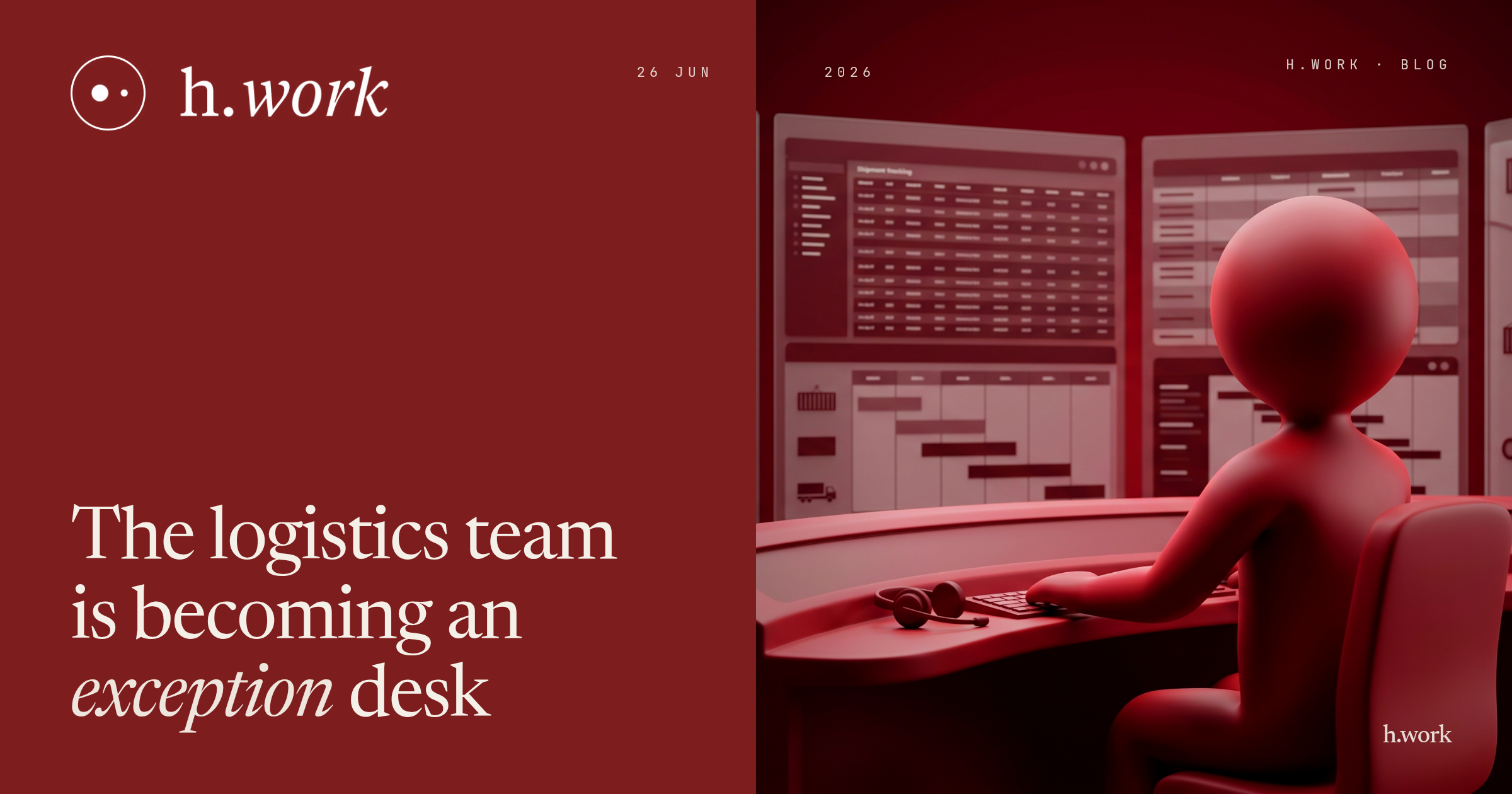
Logistics used to be managed around movement. Goods left a warehouse, crossed a border, arrived at a dock, moved through a carrier network, and reached the customer. The work was measured in miles, pallets, containers, trucks, ETAs, and delivery windows.
That is still true, but it is no longer the whole job.
For many logistics teams, the hardest work now sits around the movement: the missing document, the delayed customs filing, the carrier update that never arrived, the customer asking for a revised ETA, the temperature reading that looks wrong, the invoice that does not match the shipment record, the handoff between a transport management system and the person who still has to make the call.
The logistics team is becoming an exception desk.
That shift matters because exceptions do not behave like clean software tasks. They arrive through email, WhatsApp, portals, spreadsheets, EDI feeds, phone calls, PDFs, and half-updated systems. They require speed, but also judgement. They are repetitive enough to overwhelm a team, but consequential enough that a bad decision can create real cost.
This is where AI work becomes practical for logistics operators. Not as a promise of a self-driving supply chain. Not as another dashboard for a manager to inspect. As role-specific operational capacity that watches the flow of work, handles the structured throughput, and escalates the decisions that need experienced human review.
The Back Office Is Where Logistics Breaks First
Most companies notice logistics problems at the visible edge: late deliveries, missed appointments, frustrated customers, carrier disputes, inventory gaps, or margin leakage.
The source is often further upstream.
A shipment is missing a document. A bill of lading has a mismatch. A customs entry needs validation. A carrier portal shows one status while the customer system shows another. A refrigerated load needs closer monitoring. A proof of delivery has arrived, but the invoice workflow has not moved. A warehouse team has updated one system, while the commercial team is still working from yesterday's export.
None of these tasks is glamorous. All of them matter.
Recent coverage of AI in logistics keeps coming back to the same operational themes: documentation, compliance checks, shipment tracking, routing exceptions, invoice verification, and carrier/customer communication. That is a useful signal. The immediate opportunity is not to replace the logistics manager. It is to absorb the coordination burden that prevents the manager from managing.
For mid-market logistics teams, that burden is especially acute. They often have enough volume to create complexity, but not enough headcount to build a large control tower, compliance team, customer operations team, and data operations team around it. The result is a familiar pattern: experienced people spend their day chasing updates, reconciling fields, forwarding documents, and deciding which exception deserves attention first.
That is expensive work to leave stuck in inboxes.
AI Specialists Fit the Shape of Logistics Work
Generic AI tools struggle in logistics because the work is not generic.
A logistics operator does not need a chatbot that can answer broad questions about supply chains. They need a role that understands a narrow job: shipment coordination, document review, carrier follow-up, customer updates, claims preparation, customs documentation, cold chain monitoring, appointment scheduling, invoice reconciliation, or exception triage.
That is the AI Specialist model.
An AI Specialist is not a blank assistant waiting for prompts. It is a named, role-specific worker deployed into the tools and channels the company already uses. In logistics, that may mean Slack or Microsoft Teams for internal coordination, email for customer and carrier updates, WhatsApp or LINE for regional operations, and integrations with TMS, WMS, ERP, carrier, and document systems.
The Specialist handles the throughput:
It monitors shipment statuses across systems. It identifies missing or conflicting information. It drafts customer updates before the customer asks. It checks whether required documents are present. It flags exceptions by urgency and commercial impact. It prepares the context a manager needs before escalation. It keeps the operational record current.
This is not a small improvement. In logistics, speed of coordination often determines whether a problem stays minor or becomes expensive.
If a late truck is caught early, the customer can be warned, the appointment can be moved, and the downstream plan can be adjusted. If a document mismatch is caught before submission, the delay may never happen. If a carrier dispute is prepared with the right shipment history, the team does not lose hours reconstructing the facts.
The value is not that AI is clever. The value is that structured work keeps moving.
The Human Layer Still Matters
Logistics is full of decisions that should not be left to automation alone.
Should a shipment be rerouted at additional cost? Should a customer receive a proactive credit? Is a customs issue routine or risky? Is a temperature excursion acceptable, or does it need quality review? Should a carrier be challenged, replaced, or given more context? Is a customer escalation commercial, operational, or legal?
These are judgement calls. They depend on context, risk, relationship value, regulation, and experience.
That is why expert oversight is not an accessory to AI work in logistics. It is the condition that makes the model usable.
In h.work's model, AI Specialists handle the repeatable execution while credentialed human experts supervise consequential decisions. The AI can gather the facts, prepare the recommendation, show the relevant history, and route the decision. The human expert reviews the edge case, applies judgement, and corrects the system where needed.
This creates three useful outcomes at once.
The company gets faster operational throughput. The team gets protection against bad decisions in high-stakes moments. The AI Specialist improves because expert corrections become better ground truth for future work.
That loop is important. Logistics work is full of local nuance: carrier behaviour, customer expectations, regional customs requirements, warehouse habits, product sensitivity, commercial tolerance, and seasonal patterns. A system that never receives expert correction stays brittle. A Specialist supervised by experienced operators becomes more useful over time.
The Better Question Is Not "Can AI Automate Logistics?"
That question is too broad to help an operator.
The better question is: which parts of logistics work are structured enough for AI throughput, and which parts require human judgement?
The split is usually clear.
AI can process documents, compare fields, monitor statuses, prepare updates, create exception queues, summarize shipment histories, draft follow-ups, and keep records aligned. Human experts should review consequential reroutes, compliance-sensitive cases, customer-impacting exceptions, quality issues, commercial disputes, and decisions that fall outside agreed rules.
This is not full autonomy. It is supervised operational capacity.
For a mid-market operator, that distinction is the point. The company does not need to reorganise around a giant transformation project before getting value. It can start with one role where the work is repetitive, high-volume, and currently slowing the team down.
A shipment coordinator. A documentation specialist. A carrier follow-up specialist. A cold chain exception analyst. A freight invoice reconciliation specialist. A customer operations specialist.
Each role has a defined scope. Each one sits inside existing workflows. Each one gives the business more operating capacity without pretending that software has replaced the need for experienced judgement.
Logistics Needs Fewer Dashboards and More Done Work
Many logistics teams already have visibility tools. They know when something is wrong. The problem is that knowing is not the same as resolving.
An alert still has to be interpreted. A customer still needs an update. A document still has to be corrected. A carrier still needs to be chased. A manager still has to decide whether the exception can be handled inside the rules or needs escalation.
That is why the next useful layer in logistics is not just another view of the network. It is work execution with an escalation path.
AI Specialists are built for that layer. They do the structured work that clogs the desk, maintain the operating rhythm across systems and channels, and bring human experts into the moments where judgement matters.
For logistics operators, the promise is practical: fewer silent exceptions, fewer manual chases, fewer avoidable delays, and more senior attention available for the decisions that actually deserve it.
The logistics team is becoming an exception desk. The companies that handle that shift well will not be the ones that automate everything. They will be the ones that know exactly where automation should stop, and where expert judgement should begin.