The Work Is Hiding Between the Tools
Mid-market teams do not need another dashboard. They need operational capacity that can work across tools, manage handoffs, and keep expert judgement in the loop.
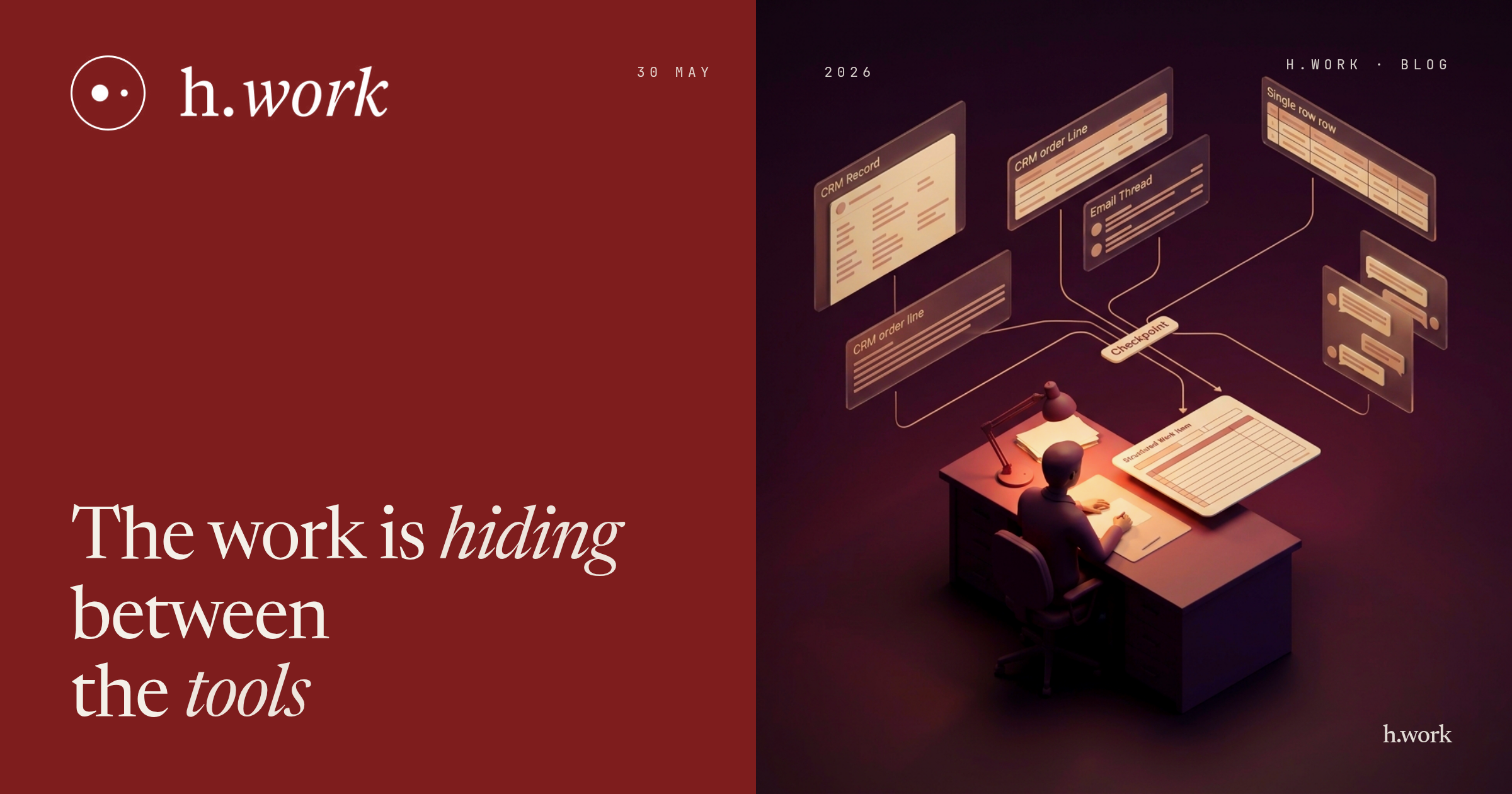
The Work Is Hiding Between the Tools
Most operational work does not live neatly inside one system.
It sits between the CRM and the inbox. Between the purchase order and the supplier message. Between the spreadsheet a manager trusts and the ERP a finance team is still cleaning up. Between the customer asking for an update and the warehouse, carrier, account manager, and invoice record that all hold a different part of the answer.
This is where mid-market companies lose time.
Not because their teams are careless. Not because they lack software. In many cases, they have plenty of software. The problem is that the work itself is distributed across too many tools, too many handoffs, and too many small decisions that never become clean workflow diagrams.
That matters because this is also where most AI deployments start to disappoint. A generic assistant can summarise a document, draft a reply, or answer a question from one source. But operations rarely ask for one clean answer from one clean source. Operations ask for movement.
Did the customer order match the latest price list?
Has the supplier confirmed the revised ship date?
Does the invoice exception need finance approval, commercial approval, or both?
Is this support escalation routine, or is it about to become a retained-revenue issue?
The work is not the message, the record, or the dashboard. The work is the handoff between them.
Mid-market operations are built on exceptions
Large enterprises can throw process teams, transformation budgets, and dedicated system owners at fragmented operations. Small companies can often solve the problem by putting the founder or a trusted generalist close to every decision.
Mid-market companies sit in the harder middle.
They are large enough to have operational complexity, but not always large enough to have clean operating architecture. A manufacturer may run sales orders in one system, production updates in another, supplier coordination over email, and customer exceptions in WhatsApp. A property manager may have leasing, maintenance, finance, tenant communication, and vendor management spread across several tools. A trading business may depend on a handful of people who know which spreadsheet is current, which customer needs a different SLA, and which exception should never be auto-approved.
The result is a quiet accumulation of coordination work.
People chase updates. Managers review routine exceptions. Senior operators get pulled into low-value questions because the system cannot tell whether the question is actually low value. New hires take months to become useful because the real operating model is not in the handbook. It is in the habits of the team.
This is why adding AI is not enough. If AI sits beside the workflow as another chat window, it becomes one more place to check. If it only works inside a single application, it may improve a task while leaving the operating bottleneck untouched.
The useful question is not: can AI answer this?
The useful question is: can an AI Specialist carry this piece of work across the tools where it actually happens, with the right boundaries and the right escalation path?
The dashboard is not the job
Many operations teams already have dashboards. They know what is late, what is pending, what is unresolved, and which queue is growing.
Knowing is not the same as resolving.
A dashboard can show that 42 customer orders need attention. It does not necessarily reconcile the order details, check the latest inventory position, draft the customer update, flag the accounts with commercial risk, and route the three unusual cases to a senior operator before anything goes out.
That is why the next layer of operational AI should look less like software and more like role-based capacity.
An AI Specialist should have a defined job. It should know the tools it works across, the records it can read, the actions it can take, the exceptions it must escalate, and the expert responsible for reviewing consequential decisions. Its value is not that it “uses AI.” Its value is that it owns a narrow operational lane end to end.
For a customer operations team, that lane might be order status exceptions.
For a finance team, it might be invoice reconciliation and deduction follow-up.
For a supply chain team, it might be supplier confirmation tracking.
For a property team, it might be maintenance triage and vendor coordination.
In each case, the job is not to replace the team’s systems. The job is to operate across them.
Fragmented tools need named responsibility
One reason mid-market workflows break down is that responsibility becomes blurry at the edges.
The CRM says one thing. The finance system says another. The account manager has context in email. The operations team has a note in Slack. The customer is waiting for a clear answer.
When a human operator handles this, they apply judgement. They know which system is authoritative, when to ask for approval, and how to avoid turning a minor exception into a customer problem. When a generic AI tool handles it without structure, the risk is obvious: it may produce a confident answer without owning the responsibility behind that answer.
h.work’s model is built around a different assumption. AI Specialists should be named, role-specific workers. They should not be anonymous automation running in the background. They should have a defined scope, a visible work history, and expert oversight attached to the decisions that matter.
That structure is especially important in mid-market companies because operational knowledge is often unevenly documented. The AI Specialist needs more than tool access. It needs a role design:
- what it monitors
- what it prepares
- what it can execute
- what it cannot execute
- when it asks for approval
- which expert reviews the edge cases
- how corrections feed back into future work
This is the difference between automation and an AI workforce.
Automation completes a task when the inputs are clean.
An AI workforce carries repeatable work through a messy operating environment, while keeping human judgement close to the points of risk.
The first deployment should be narrow
Mid-market companies do not need to begin with a grand AI transformation programme.
They usually need one painful workflow to become less dependent on constant human chasing.
The best starting points have three traits.
First, the work is frequent. It happens every day or every week, not once a quarter.
Second, the work crosses systems. If the whole task already lives cleanly inside one tool, the tool vendor may be enough. The stronger h.work use case is where the work moves across email, chat, spreadsheets, ERP, CRM, accounting, ticketing, or marketplace systems.
Third, the work has clear escalation points. Not every exception should go to a human, but the important ones should. The company should know which decisions affect revenue, compliance, customer trust, financial accuracy, or operational risk.
A good first AI Specialist deployment might not sound dramatic. It may be an order exception coordinator, a supplier follow-up specialist, a reconciliation analyst, or a maintenance triage coordinator.
That is the point.
Operational leverage rarely begins with the most glamorous work. It begins with the work that creates drag every day.
The future of operations is not fewer humans
The lazy version of the AI workforce story is that companies will simply remove people from operations.
That is not how serious operators think.
The better model is a different allocation of human attention. AI handles the throughput: monitoring, checking, drafting, reconciling, chasing, logging, and preparing. Human experts handle the judgement: unusual cases, exceptions with commercial risk, compliance-sensitive decisions, and moments where the rulebook is not enough.
For mid-market teams, this matters because the most expensive person in the workflow is often spending too much time on coordination. A senior operator should not be manually chasing routine status updates. A finance lead should not be spending their best hours matching obvious records. A customer lead should not be rewriting the same apology with slightly different order details.
They should be reviewing the cases where their judgement changes the outcome.
That is where AI Specialists can make operations feel different. Not by pretending the business is simpler than it is, but by absorbing the structured work that sits between tools and making the exceptions visible sooner.
Mid-market companies do not need another dashboard that tells them work is stuck.
They need capacity that can move the work, show its reasoning, escalate the right decisions, and improve with expert correction.
The work has been hiding between the tools for years.
That is exactly where the AI workforce has to operate.
Slug: the-work-is-hiding-between-the-tools
Meta description: Mid-market teams do not need another dashboard. They need operational capacity that can work across tools, manage handoffs, and keep expert judgement in the loop.